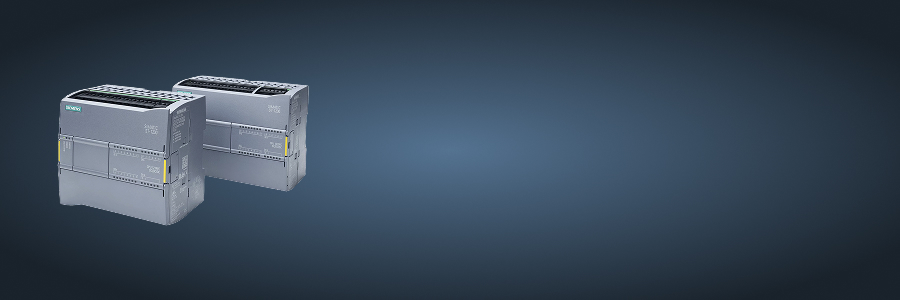
Engineers and plant managers search for robust control systems to handle everything from simple conveyor lines to complex assembly processes. This guide breaks down Siemens PLC basics for 2026, including S7-1200 G2 and S7-1500, critical specs for industrial setups, Siemens PLC programming tips from TIA Portal, and smart buying advice. Supported by the latest innovations from Siemens, it helps you select the right Siemens PLC Controllers for automation in manufacturing, textiles, or packaging. Step by step, build your knowledge!
Overview: Key Takeaways on Siemens PLC for 2026
- Top Models: S7-1200 G2 for basic tasks with motion control; S7-1500 high speed, safety-integrated operation.
- Core Specs: Bit processing up to 10 ns, PROFINET/OPC UA support, and scalable I/O from 10 to thousands of points.
- Programming Essentials: Use TIA Portal V20 for drag-and-drop logic, simulation, and drive integration, such as SINAMICS V20.
- Buying Tips: Lifecycle consider – avoid phasing-out S7-300; Budget for 20% -30% expansion headroom.
- Trends: AI and cloud connectivity improve factory efficiency as 2025’s S7-300 end-of-life approaches.
Discover how Indian factories are improving productivity with Siemens PLC automation.
A Quick Look at Siemens PLC Evolution
For decades, Siemens has shaped industrial control systems used in factories worldwide. Picture a textile mill anywhere in the world where threads spin freely thanks to a small controller that controls speeds and sensors. Such is the quality Siemens PLC Controllers offer. These controllers accept sensor inputs, process logic, and output commands for motors or valves. In automation, they reduce downtime and errors, which is key in sectors such as automotive and pharma, and more.
Exploring Siemens PLC Models for 2026
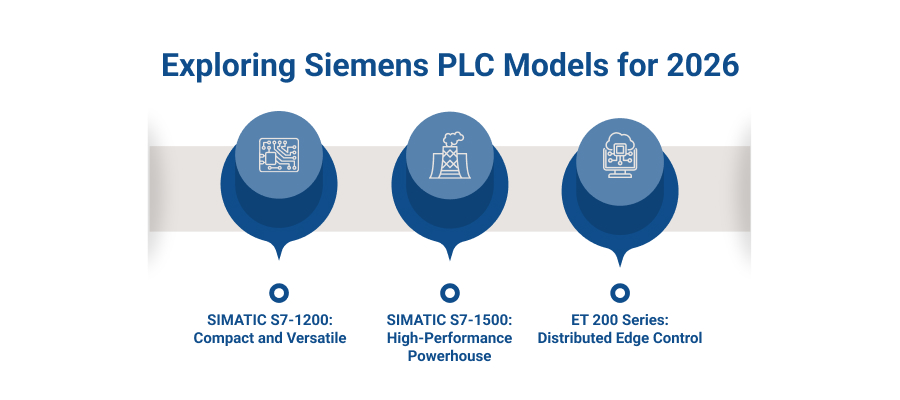
Siemens ‘SIMATIC series offers control solutions for small machines through large enterprise networks. Each platform is designed for a given automation scale and can be adapted from compact architectures to sophisticated machine-level controls.
1. SIMATIC S7-1200: Compact and Versatile
The S7-1200 G2 family targets compact to medium-complexity control applications. Launched years ago and updated in mid-2025, this model is suitable for basic to mid-level automation. This package packs integrated motion control, ideal for packaging lines or simple robotics. Expect faster execution and higher PROFINET throughput with the G2 upgrade, which is suitable for factories upgrading from legacy gear.
Applications and Features:
- Powerful processor with more memory than the previous generation.
- Integrated safety/fail-safe capabilities for machine operations.
- Communication interfaces built in (PROFINET, etc) and modular expansion support.
- Diagnostic transparency via NFC, web server, and advanced monitoring functions.
- Simple motion-control tasks, such as single-axis or coordinated-axis motion, are performed in compact systems.
- Systems that require scalable safety integration without large cost overhead..
2. SIMATIC S7-1500: High-Performance Powerhouse
For more demanding setups, the S7-1500 supports 2025 CPU enhancements for 10 ns per bit operation. It’s built for big I/O counts and motion-heavy apps. From machine centres to complete production lines, this controller provides advanced diagnostics, modular signal capabilities, and future-ready connectivity for industrial installations.
Applications and Features:
- Modular, scalable design with high CPUs, large memory, and wide I/O expansion.
- Support for PROFINET OPC UA, diagnostics, and connectivity for edge/cloud.
- Advanced motion control, safety functions & high-speed signal processing.
- Complex production lines with lots of I/O points, high-speed requirements, or with multi-axis motion coordination.
- Industries like Automotive or Large-scale manufacturing, where Diagnostics, Safety, and Connectivity are important.
3. ET 200 Series: Distributed Edge Control
Not a complete PLC, but a smart extension, ET 200SP or MP controllers are remote brains for near-field devices. They connect via PROFINET to a central Siemens PLC, reducing wiring costs.
Why It Fits 2026
With outdated models like the S7-300 slowly fading away, ET 200 steps in to replace them in decentralized setups across sprawling plants. In installations where cable length, wiring complexity, or modular growth are key concerns, decentralised I/O offers cost and time savings. It is also loaded with flexible integration of safety, motor starter, pneumatic controls, IO-Link, and fast diagnostics. The ET 200 series will soon become a standard for decentralized automation.
Learn how investing in Siemens PLCs can smartly drive efficiency in your packaging and textile operations.
Breaking Down Siemens PLC Specs
Power is available at 24V DC or 120/230V AC, and most CPUs consume less than 5W for energy-conscious designs. Memory ranges from 50 KB in S7-1200 to 20 MB in S7-1500, enough for ladder logic or function blocks. Communicatio is built in PROFINET for real-time Ethernet and OPC UA for data sharing with cloud platforms. Safety specs include SIL 3 ratings for failsafe models, which are important for guarding conveyor pinch points.
|
Spec Category |
S7-1200 G2 |
S7-1500 |
|
Processing Speed |
0.08 µs/instruction |
10 ns/bit |
|
I/O Expansion |
Up to 11 modules |
Unlimited via backplane |
|
Temp Range |
-20°C to 60°C |
-25°C to 70°C |
|
Certifications |
CE, UL, ATEX |
Plus FM, GOST-R |
These figures matter in hot, dusty environments like steel mills, where toughness prevents failures.
Mastering Siemens PLC Programming
Mastering Siemens PLC programming starts with TIA Portal V20, the streamlined engineering platform Siemens introduced on December 04, 2024. It brings together programming of Siemens PLC units, HMIs, and even drives in one workspace to reduce back-and-forth that slows teams down. It makes wiring up a sequence or writing a full PID controller loop for oven temps feel less like a problem and more like a path to running code.
- Ladder Logic Basics: Ladder diagrams are like old relay panels that help you see steps, like turning a conveyor when a sensor trips. This is perfect for fast setups in packaging or assembly lines.
- Complex Math in Structured Text – Part I: When you need calculations like setting a pump flow rate, structured text does the heavy lifting in a loop and equations with no frills.
- Offline Simulation Power: Open TIA’s simulator and run your code on a virtual Siemens PLC Controllers setup – no risk of frying real hardware. It picks up glitches early like a forgotten timer in a batch mixer.
- Drag-and-Drop Efficiency: Use premade blocks from the library for counters or alarms. On bottling lines, this means resetting counts in seconds instead of coding from scratch.
- Version Control Smarts: TIA tracks edits to avoid chaos on handoffs, which is important on round-the-clock shifts where one tweak can affect the entire plant.
Build Skills with Free Resources: Take a look at Siemens online tutorials – from beginner rungs through safety-integrated code – for deployment on a live textile winder – slow speeds stop yarn snapping.
Wrapping Up: Your Path to Smarter Automation with Siemens PLC
From the compact S7-1200 G2 to the high-speed S7-1500, Siemens PLCs are still the basis of reliable industrial automation. This guide steps through the key models, basic specifications for tough environments and practical programming workflows, and what to expect in 2026. We at Naksh Technology Solutions LLP have seen firsthand how these Siemens PLC Controllers ease operations across factories from Cadbury lines to textile mills. Ready to upgrade or dive into a new project? Let’s chat about tailoring a Siemens PLC solution that fits your setup perfectly. We’re here to make automation work for you.
FAQs Related to Siemens PLC:
Q. Which Siemens PLC series is best in 2026?
A. In 2026, the SIMATIC S7-1200 and S7-1500 series remain the most popular due to their scalability, performance, and seamless integration with Siemens TIA Portal.
Q. What software is used to program Siemens PLCs?
A. Siemens PLCs are programmed using TIA Portal (Totally Integrated Automation Portal), which supports ladder logic, FBD, and STL programming.
Q. How do I choose the right Siemens PLC model?
A. Choose based on I/O requirement, communication protocols, processing speed, scalability, and compatibility with existing automation systems.
Q. What communication protocols do Siemens PLCs support?
A. Siemens PLCs support PROFINET, PROFIBUS, Modbus TCP, Ethernet/IP, MQTT, and OPC UA, depending on the model.
Q. Are Siemens PLCs suitable for Industry 4.0 applications?
A. Yes, models like S7-1500 support IIoT connectivity, real-time diagnostics, secure data exchange, and cloud integration, making them Industry 4.0 ready.
Q. What industries use Siemens PLCs?
A. Siemens PLCs are used in automotive, textile, food & beverage, pharmaceuticals, packaging, power plants, and OEM machinery.
Q. Where can I buy Siemens PLCs in India?
A. You can purchase from authorized Siemens distributors, automation dealers, or directly from companies like Naksh Technology and other Siemens channel partners.